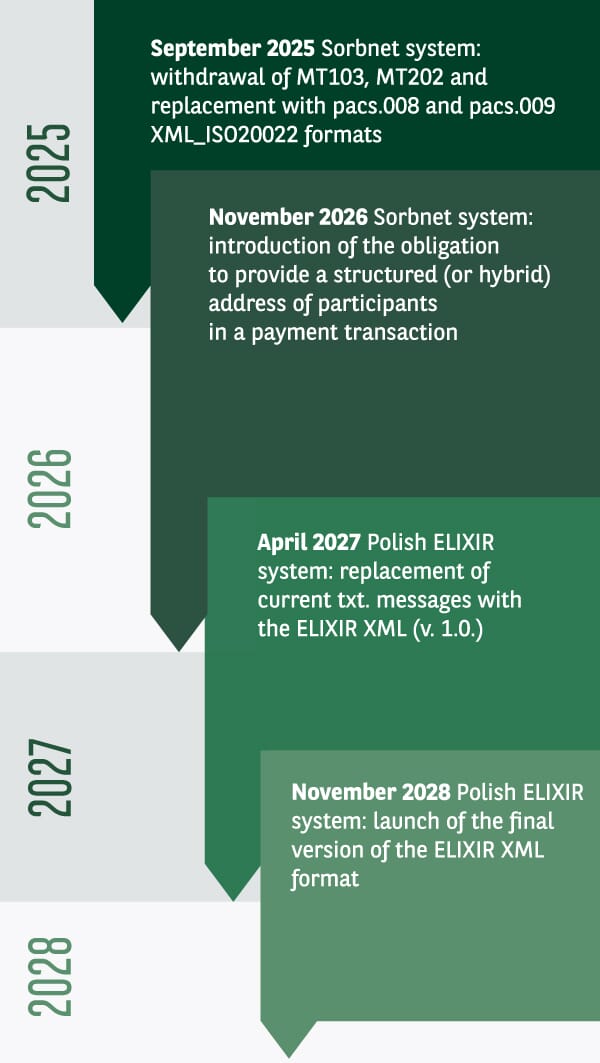
First stage of migration: completed
The first stage took place in March 2023. Payment messages for cross-border and high-value transfers used in the TARGET2 settlement system were migrated to the XML_ISO20022 standard. TARGET2 is a pan-European real-time settlement system for EUR, involving European central and commercial banks. This stage concerned only interbank communication and did not affect bank Customers.
Second stage: global migration
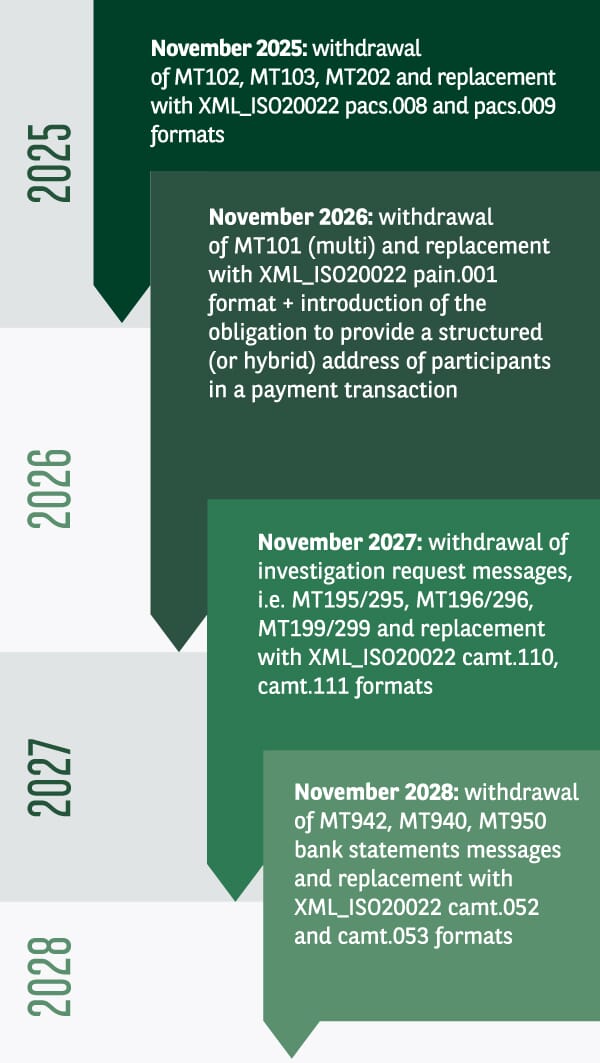
November 2025
- Key MT payment messages in groups 1 (MT102, MT103) and 2 (MT202, MT202COV) were withdrawn from the global interbank area.
- They were replaced by the new XML_ISO20022 formats: pacs.008 and pacs.009.
November 2026
- SWIFT will withdraw MT101 messages and they will be replaced with the new formats: XML_ISO20022 pain.001
- Payers will still be able to send individual MT101 messages and use their paid conversion by SWIFT into the XML_ISO20022 pain.001 format (using MT101 in the so-called multiplied version, that is multiple messages in one instruction, will not longer be possible).
- The use of structured addresses for payment participants in commercial transfers will be made mandatory. Thanks to this change, address details will be structured and highly detailed, ensuring unambiguous and error-free identification of participants.
Structured addresses in ISO20022
As at present, we will:
- automatically download your data (i.e. the data of the transfer payer) from our systems,
- place them in a transfer, in an orderly manner and in accordance with the XML_ISO20022 standard.
Transfers to countries in the European Economic Area (EEA) will be accepted without providing the payee's address. These rules will continue to apply.
- If the payee's address is provided in the EEA transfer, the payment must include at least the name of the payee's city and country of residence, which will be converted to an ISO code in the payment message.
Change in transfers to countries outside the EEA
- For transfers that require the payee's address, three address formats are accepted until 15 November 2026: unstructured, semi-structured (so-called hybrid address) and structured.
- After 15 November 2026, we will no longer be able to process payments to countries outside the EEA that contain unstructured counterparty addresses. Such transfers will be rejected by the SWIFT network and settlement systems.
- Migration to the XML_ISO 20022 standard requires the address data you provide in payment instructions to be more precise and organised. A structured address makes it possible.
- We encourage you to use the new standard as more and more non-EEA banks now require to provide this information. Its absence may cause delays in the execution of payments and generate additional costs of the payee’s bank.
Changes already in place
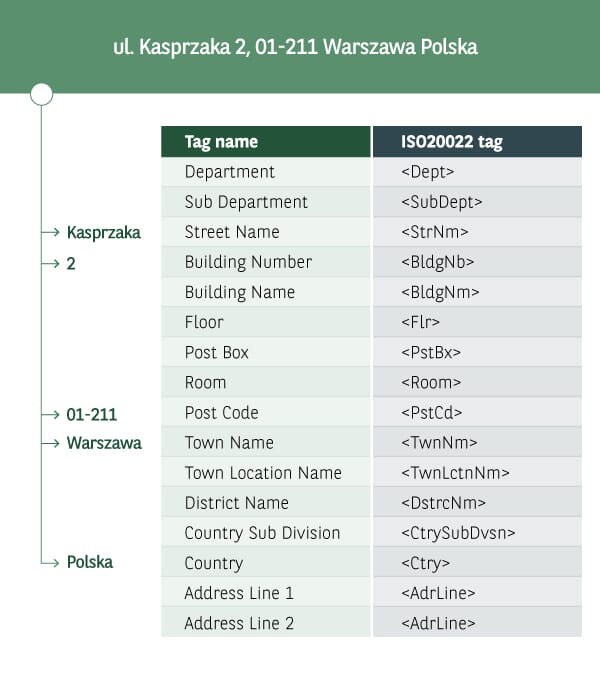
A fully structured format of the transaction participant has been available since 2023. It contains only defined fields that are arranged in the payment message in a fixed way and according to a strict pattern (ISO20022 structure).
Since November 2025, a new, semi-structured format for the postal address, the so-called hybrid address, has also been available. This format contains some structured address fields, i.e. at least the name of the city and country of residence of the participant in the payment transaction.
Postal address mapping to structured address formula
Note:
As a payer, you have the data of your counterparties.
By 15 November 2026, you must ensure that counterparties' addresses used in payment orders are provided in a fully structured or at least semi-structured, i.e. hybrid, format.
- This applies to the following participants in the payment chain to countries outside the EEA:
- payee
- actual payer/final payee (if applicable)
- related acquirers (in the absence of BIC).
- In instructions sent using the MT101/pain.001 instruction for transfers by other banks where your accounts are maintained, the provision of structured or at least partially structured (hybrid) data also applies to data concerning the payer, i.e. data directly related to you.
What comes next (SWIFT 2027, 2028)
What does the migration process look like in Poland?
- Migration to the XML_ISO20022 format is taking place in parallel in Polish settlement systems.
- In September 2025, the Polish Sorbnet3 system was migrated.
- This is Poland’s real-time interbank settlement system for PLN.
- In 2027, the Polish Elixir system is expected to migrate to the XML_ ISO20022 standard.